SalMar’s Sustainability Summary
Passion for Salmon

World’s best food producer for sustainable growth 2025
TIME and Statista
World’s most sustainable food producer in 2026
Corporate Knights at WEF

NO
Harvesting and processing
Roe
Fry
Smolt
Salmon

SalMar has a fully integrated value chain from roe to slaughter. Want to know more about the salmon life cycle? Watch the information video here.
The Salmon Life Cycle

Sustainability in Everything We Do
For SalMar, sustainability is about protecting fish, the environment and people. In the following, you will receive an introduction to SalMar's operations and a summary of our most important sustainability results.

Click the numbers to see more info
UPSTREAM VALUE CHAIN

1. Feed
Feed is a key part of SalMar’s upstream value chain. Fish health, growth and overall performance are all highly dependent on the right feed. Our feed combines marine and vegetable raw materials, as well as important vitamins and minerals necessary to support healthy salmon. SalMar solely use feed that is certified as deforestation and conversion-free by an accredited third party.
Want to learn more about our feed? Read more in our Annual Report (page 60).
UPSTREAM VALUE CHAIN
2. Packaging
Packaging is necessary to ensure that our salmon is fresh, has a high quality, and is safe to eat when it arrives at the end customer. Packaging safeguards the product during transport and storage by maintaining low temperatures and limiting exposure to air, light and physical handling. This preserves key quality attributes such as texture, colour, and shelf life, ensuring the salmon reaches the market in optimal condition.
UPSTREAM VALUE CHAIN
3. Broodstock
Broodstock are the parent fish that provides the eggs and sperm (milt) required to produce new generations of salmon, representing the starting point of our integrated value chain. Careful selection and management of broodstock are essential to ensure strong genetics, fish health, and consistent quality. This forms the biological foundation for robust growth, high survival rates, and predictable performance throughout the production cycle.
OWN OPERATIONS
4. Smolt
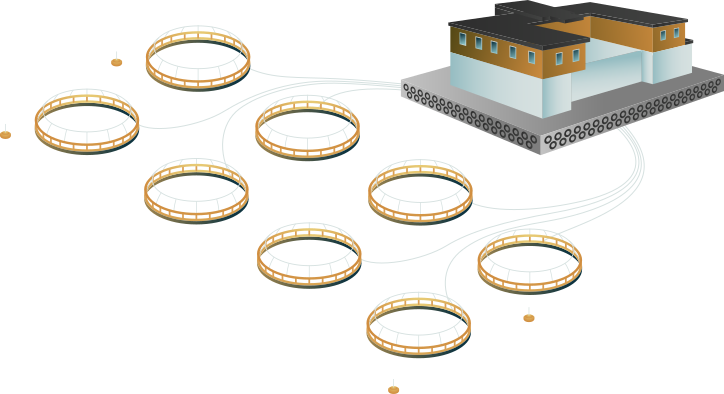
Roes develop in incubators before hatching into fry, which initially rely on their yolk sac for nutrition. Once ready, they are transferred to tanks for feeding and growth under controlled conditions. As they mature, the fry is sorted, vaccinated, and prepared for transfer to seawater. The transition to seawater, known as smoltification, involves key physiological changes that enable the fish to adapt to a marine environment.
OWN OPERATIONS
5. Well-boat smolt
After 9-12 months, the smolt is transported by well-boats to the sea. The smolt is now ready to spend the remainder of their lives at sea and grow into adult salmon.
OWN OPERATIONS
6. Growth at sea
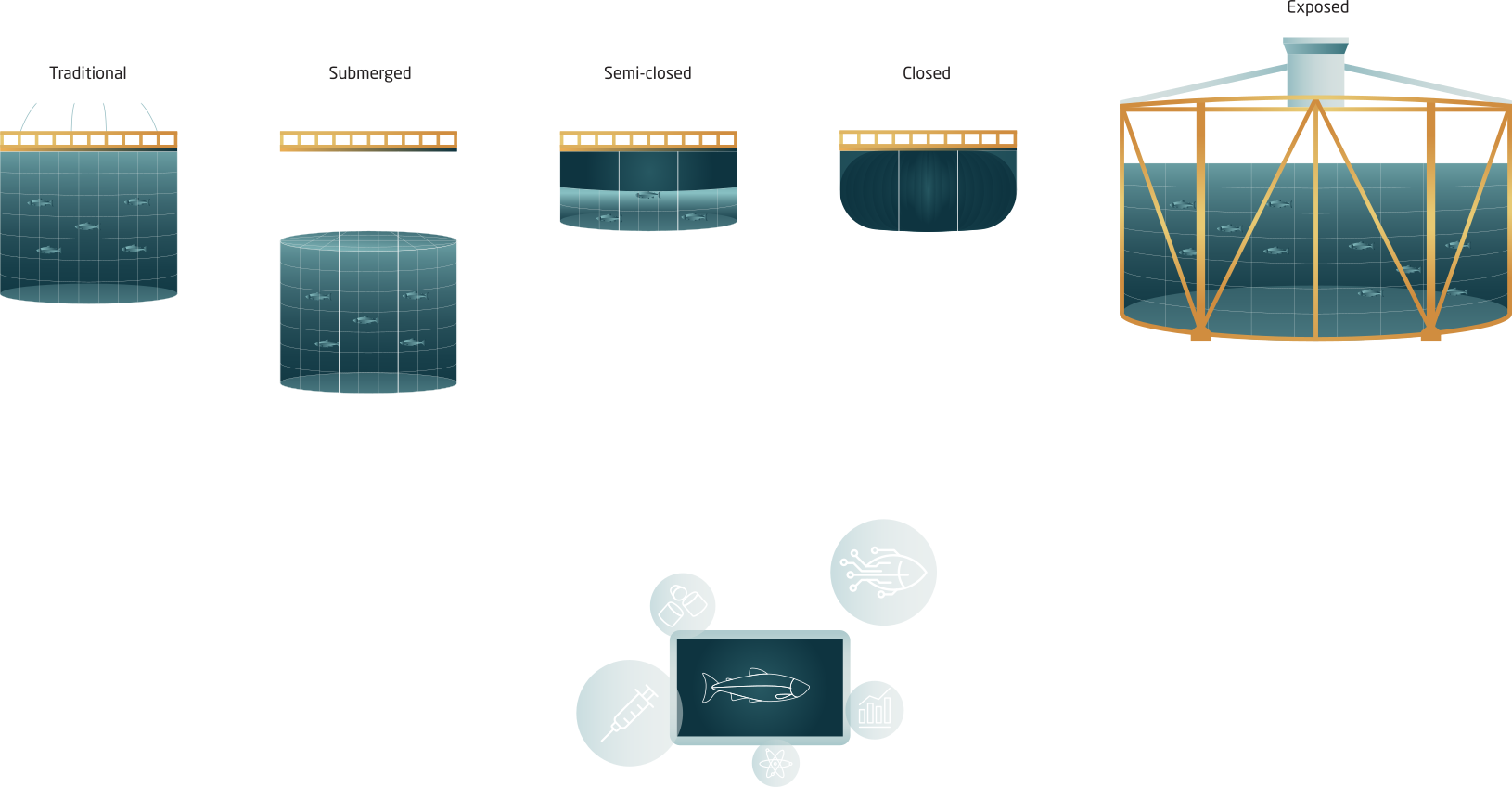
At sea, SalMar employs a variety of farming technologies, including traditional open net pens, submerged, semi-closed, closed and exposed production systems. The most suitable farming system depends on the site’s lice pressure, water exchange rates, wave and current forces, upwelling patterns and much more. During this phase, the salmon are regularly sorted to ensure optimal development and uniform growth.
OWN OPERATIONS
7. Well-boat salmon
About a year after transfer to sea, the salmon are ready for harvest. The salmon are then transported live by well-boats to the processing plant. The fish are placed into holding pens outside the processing facility to relax, before being pumped into the processing plant.
OWN OPERATIONS
8. Processing
In our processing facilities, the salmon are stunned, killed and bled out using high-tech equipment, and always in accordance with applicable regulations. After slaughter the salmon is subject to various degrees of processing. A significant percentage of the harvest goes on to local secondary processing where the salmon is made into ready-to-eat filets, portions and loins before being sent to customers and consumers around the world.
OWN OPERATIONS
9. Research & Development
Closing knowledge gaps in fish welfare and developing solutions to improve survival rates are key priorities for SalMar. We are actively engaged in a wide range of research and development projects aimed at enhancing fish health, welfare, and biosecurity while reducing aquaculture’s environmental impact.
We also collaborate with our feed supplier to explore novel ingredients, such as algae, insect meal, kelp, salmon oil, seafood trimmings, and surplus processing materials, that complement traditional inputs and support more sustainable, resource-efficient aquaculture.
OWN OPERATIONS
10. Salmon Living Lab
SalMar has launched the Salmon Living Lab, an ambitious innovation and research initiative aimed at closing critical knowledge gaps in fish biology to improve fish health and welfare. The initiative brings together industry leaders, academic institutions, and NGOs to develop knowledge and address challenges that cannot be solved by individual players alone.
Read more about the Salmon Living Lab here.
OWN OPERATIONS
11. Sales and logistics
Salmon is sold either as whole gutted salmon (fresh or frozen), fillets, in individual portions or as a wide range of other products and by-products, which are distributed to markets around the world. SalMar have sales offices in six different countries in Asia to ensure necessary proximity to central markets. In all, SalMar’s sales department distributes salmon to more than 50 different countries. Integrated logistics ensure that products are transported quickly and safely, maintaining freshness and quality throughout the global supply chain. SalMar ensures full traceability of its products from roe to plate.
DOWNSTREAM VALUE CHAIN
12. Waste management
SalMar contributes towards circular economies by sending our production waste to companies who further process these substances into marine oils and pet food ingredients. This ensures that valuable marine nutrients are utilized rather than discarded. Organic waste at smolt facilities, such as from faeces and uneaten feed, is sent to biogas production.
DOWNSTREAM VALUE CHAIN
13. Transportation
Salmon are distributed globally via airplanes, ships, trucks, and trains, ensuring delivery to markets worldwide. The mode of transport is selected based on flexibility, cost efficiency, logistical suitability and environmental impact. SalMar is working to increase its use of rail instead of road transport and sea freight instead of air freight in order to reduce its downstream carbon footprint.
DOWNSTREAM VALUE CHAIN
14. Customer
SalMar supplies a broad customer base, including retailers, restaurants, and wholesalers, providing high-quality salmon products tailored to different market needs.
DOWNSTREAM VALUE CHAIN
15. Consumer
Finally, salmon products reach the end consumer, completing the value chain and allowing consumers to enjoy fresh, safe, and sustainably produced salmon. Salmon is rich in Omega-3 fatty acids, specifically EPA and DHA, as well as vitamin B12, vitamin D, selenium, and proteins, all of which provide significant benefits for both mental and physical health. Research has demonstrated that consuming oily fish, such as salmon, can help reduce the risk of cardiovascular disease. The World Health Organization, along with numerous other reputable institutions, advocates for increased consumption of salmon as part of a healthy diet for all ages.
SalMar’s Value Chain
SalMar’s journey 1991-2026 and ahead

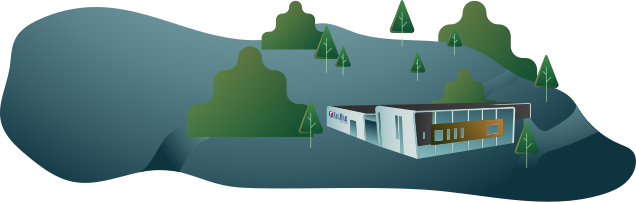
Production area
Frøya

Milestone
SalMar is founded in Frøya off the coast of Central Norway following the acquisition of one license for the production of salmon and a harvesting/processing plant. The company’s primary business was the processing of frozen salmon.

Harvest volume
(tons)

Number of meals
1991
2000/01
2007
2015
2017
2022
2026
SalMar drives development and innovation in the aquaculture industry. New production methods, new technologies, new insights, all to optimize fish welfare and drive sustainable growth. Read more about SalMar’s most recent R&D launch here.
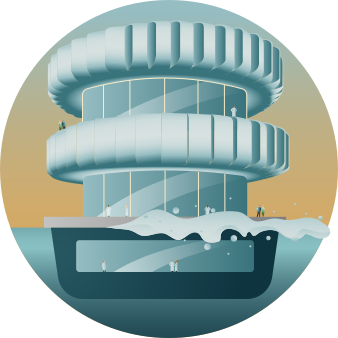
SalMar drives development

Survival rate
The survival rate is the proportion of salmon that survive production at sea.
Feed conversion ratio
The feed conversion ratio is defined as the amount of feed used per kilogram of fish produced.
Antibiotics
SalMar will only use antibiotics in exceptional circumstances as a last resort for saving fish lives. Use of antibiotics is completely phased out from routine usage. In 2025, SalMar did not utilize antibiotics at all. Read our antibiotics policy here
Number of escaped salmon
It was less likely for a salmon to escape from SalMar's sites in 2025 (0.000013%) than to become a Lotto millionaire in Norway on a random Saturday (0.000019%).
Farming on the salmon’s terms
Our goal is to produce sustainable and healthy protein for an ever-growing world population, and we will do so on the salmon's terms.
Climate and Environment
Salmon's climate footprint is low compared to other animal protein sources. From an already climate-friendly starting point, SalMar is reducing its climate footprint in line with the Paris Agreement.
CERTIFIED SITES
of SalMar's facilities are certified according to ASC or GlobalGap.
ENVIRONMENT
of SalMar's facilities have good or very good environmental status.
REDUCED CARBON FOOTPRINT
People and Society
Sustainable development is about local value creation, knowledge development and a good life for the individual.
HSE
number of injury incidents per million working hours in 2025, also called H-number
SALMAR FUND
initiatives sponsored in 2025.
Read more about the Fund here.
SHARE OF LOCAL PROCESSING
of SalMar's volumes were processed in Norwegian coastal municipalities in 2025
VISITOR CENTERS
people visited SalMar's visitor centers in 2025. Read more about the centers here.
Read the full story
Download the Annual Report 2025
© SalMar 2026
Design Bly.as